AI Assistant for Websites: What It Is and Why Businesses Need It
21 May 2026
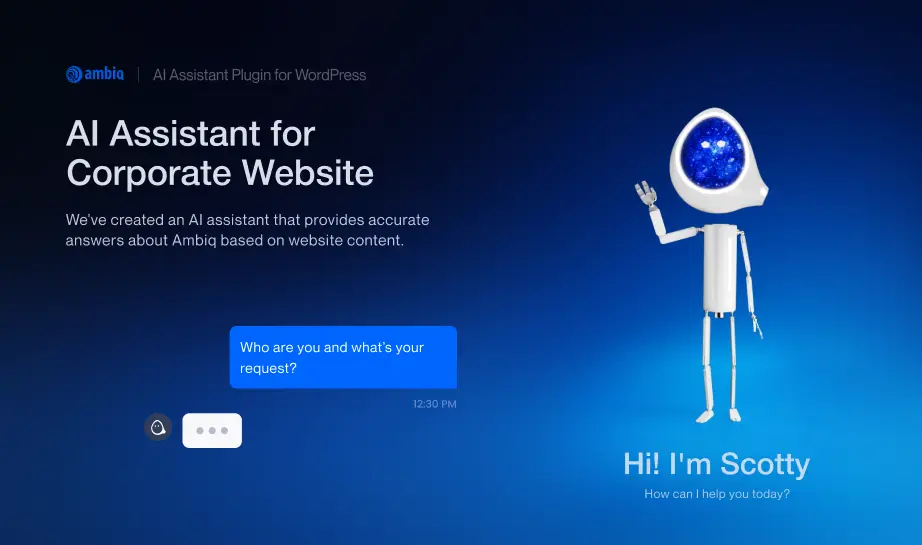
A website is always an environment where users expect speed, clarity, and a personalized approach. While these needs were traditionally met through design, structure, and content, artificial intelligence is now fully entering the picture. Today, this is not just a trend, but a massive shift: according to Statista, the AI technology market is estimated at approximately $255 billion in 2025 and is projected to grow to over $1.218 trillion by 2030.
And the AI assistant is one of the most noticeable manifestations of this transformation on the web.
What is an AI assistant, and how does it differ from a chatbot?
An AI assistant is an intelligent system integrated into a website that interacts with the user in a conversational format. At first glance, it may resemble a regular chatbot, but the difference between them is fundamental.
Classic chatbots operate based on predefined scenarios: they have pre-written response scripts and logic. They are effective for simple tasks but start to “break down” when the user goes beyond the scope of the anticipated scenario.
Unlike classic scripted chatbots, an AI assistant:
- understands the context of the query
- analyzes user behavior
- generates responses in real time
- learns from every interaction
In fact, it’s your digital consultant who’s always by your side.
Why should businesses integrate an AI assistant into their website?
Integrating an AI assistant isn’t just a “feature for the sake of a feature,” but a tool that directly impacts business metrics.
One of the key advantages of such an assistant on a website is speed. The user receives a response the very moment they have a query. They don’t need to search the site or wait for a manager’s response, and this directly impacts conversion: the fewer barriers, the higher the likelihood of action. It helps users quickly find the information they need, explains complex concepts in simple terms, and literally guides them to the desired result.
Personalization is the second key component. An AI assistant can tailor responses based on the user’s behavior, interests, or previous interactions with the site. This creates the feeling that the product “adapts” to the person.
Imagine an online store: instead of manually filtering through dozens of products, the user can simply describe what they need and receive relevant recommendations. This level of personalization not only improves the experience but also directly impacts sales.
An AI assistant also reduces frustration. Whereas users might have previously left the site without finding an answer, they now receive one instantly.
Additionally, it’s a scalable tool. A single assistant can handle dozens or even hundreds of queries simultaneously without overburdening the support team. As a result, the business saves resources while simultaneously improving service.
And it’s worth mentioning brand image separately. Having AI solutions on the site reinforces the perception of the brand as modern and tech-savvy.
Indirect impact on SEO and website performance
Although an AI assistant is not an SEO tool in the traditional sense, it significantly influences behavioral factors.
Users spend more time on the site, engage with the content, and are less likely to leave pages because they quickly find the ones that interest them. All these signals positively impact search engine rankings.
Additionally, AI can help keep the website up-to-date: analyzing content, highlighting weaknesses, and optimizing information structure. This makes the website more “alive” and relevant.
Bambuk Case Study: AI Assistant for the Ambiq Website
An interesting example of AI implementation is our project for Ambiq.
The client’s request was: “We want a chatbot for the website,” though there was no clear understanding of exactly what task it was supposed to solve. In Ambiq’s case, user queries were much broader and less predictable, and the bot simply wouldn’t have been able to handle them without constant manual script updates.
Instead, the product already had a strong foundation for implementing an AI solution.
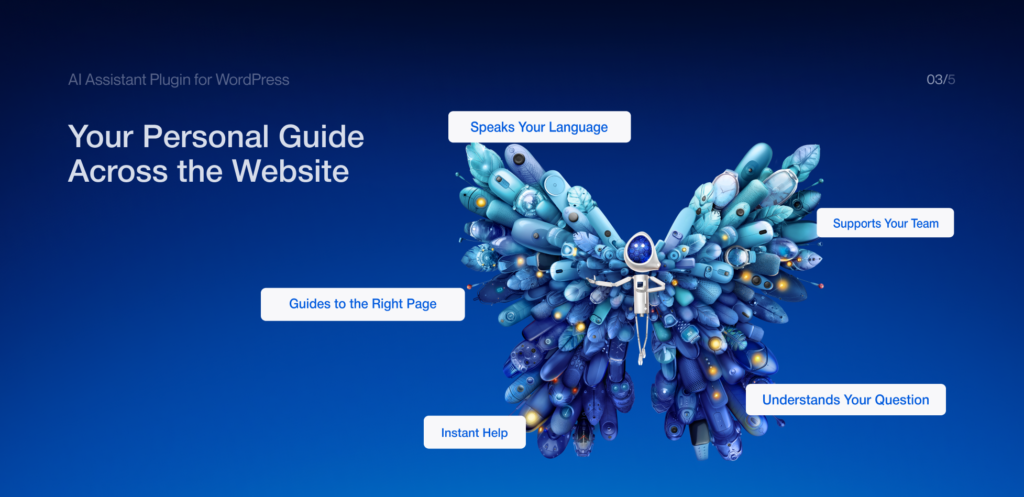
First, Ambiq has its own character, which it made sense to “bring to life” and make the point of communication with the user. An AI assistant allows not just responding to queries, but speaking on behalf of the brand with a specific personality, tone, and mood.
Second, the website had a large knowledge base with over 1,000 articles. These types of projects are best suited for implementing AI assistants: when there is a lot of structured content, product descriptions, benefits, and a blog, where AI can use this database to provide relevant answers to user queries.
At the same time, it’s important to understand the limitations: the site had no additional content beyond what was already published, so the assistant couldn’t act as a full-fledged consultant with extensive expertise. But there was another clear need to help users navigate the information more quickly.
As a result, we redefined the task and created an AI assistant that essentially acts as a smart search engine for the site’s database, supplemented with a marketing function.
How did it go?
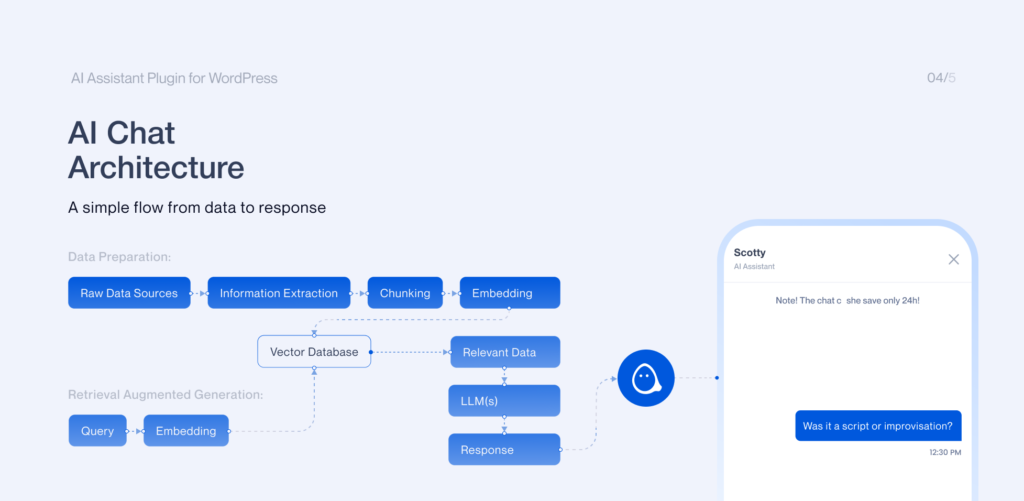
The work began with data preparation. We crawled the website, extracted all the text content, stripped it of unnecessary elements, and broke it down into logical segments that preserve the context. This is a critically important step, as the quality of the AI’s responses directly depends on the quality of the prepared information.
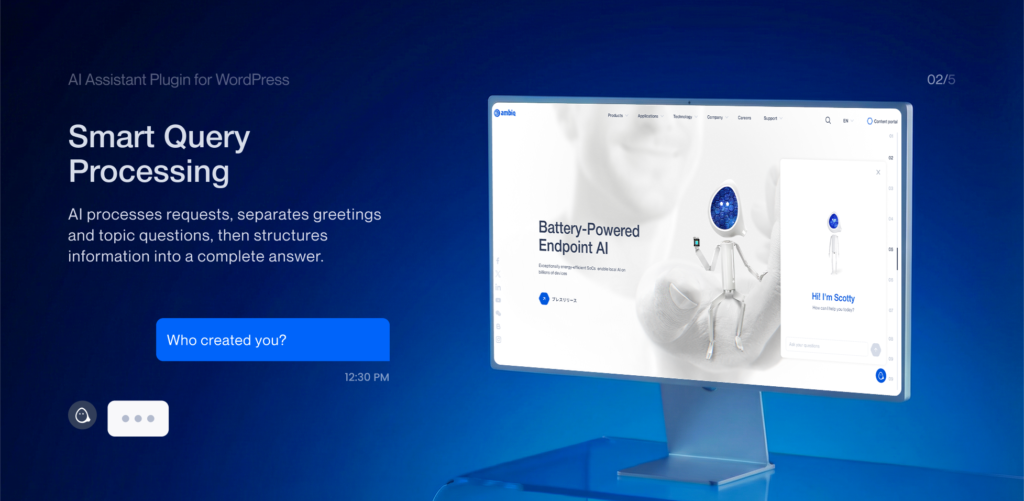
Next, we built the interaction logic. When a user enters a query, the system analyzes it, filters out unnecessary phrases, and identifies the most relevant content fragments. The response is then generated based on these fragments. If the required information is unavailable, the assistant does not fabricate a response but instead politely declines the request or redirects the user.
To ensure speed and quality, the Ambiq team also upgraded its database to a vector format. This significantly accelerated search and response times, making interactions virtually instantaneous.
We saw a distinct benefit after launch in user behavior. An analysis of queries revealed exactly how people formulate questions and what they are looking for first and foremost. It turned out that even the content already on the site does not always align with their thought processes. This allowed us to review the structure of the texts, highlight key points, and formulate more precise key phrases.
As a result, the client received a fully-fledged tool: the assistant helps users find information, keeps them on the site, and enhances the overall experience of interacting with the product.
Where AI assistants are most effective
Such solutions deliver the greatest value in products with a large amount of information or complex logic: services, SaaS platforms, e-commerce, and corporate websites.
One format that works particularly well deserves special mention—the combination of a simple landing page with a deep knowledge base. On one hand, the user lands on a clear, structured page; on the other, they have access to a large volume of information that the AI assistant helps “unpack” into a convenient response format.
The foundation of effectiveness is a high-quality, structured database: product descriptions, articles, and documentation. It is from this database that the assistant generates responses. It’s also important to consider security, as all data must remain within the system without the risk of leakage.
In addition to external use, AI assistants work well within companies too: they help with documentation, task management, and information sorting.
But there is an important caveat: AI only works when there is a clear task. Simply “adding an assistant” is not enough. You need to understand what problem it solves and what value it creates for the user.
Conclusion
In today’s world, an AI assistant is a logical step in website development. It transforms a static product into a living system that interacts, assists, and offers suggestions. For businesses, this is an opportunity to simultaneously improve the user experience, optimize processes, and enhance their product.
And in the face of growing competition, such tools are becoming not just an advantage, but the new standard.
If you feel that your website could perform better, respond faster, explain things more clearly, and convert more effectively, then it’s time to consider integrating AI right now. Reach out to Bambuk and our panda and we’ll help you define the task, find the right format, and implement a solution that works.